Maritime Labour Convention (MLC 2006) Explained
Maritime Labour Convention (MLC 2006) Explained
The shipping industry depends on skilled seafarers who spend long periods away from their homes while working in demanding environments. Therefore, protecting their rights, safety, health, and welfare is essential for a responsible maritime industry. The Maritime Labour Convention (MLC 2006) is one of the most important international frameworks created to protect seafarers. Developed by the International Labour Organization, the Convention establishes minimum standards covering employment, accommodation, food, medical care, safety, welfare, and other aspects of life and work at sea.
For ship owners, ship managers, crew management companies, maritime agents, and seafarers, understanding the MLC is important because compliance is directly connected with safe and responsible vessel operations.
What Is the Maritime Labour Convention (MLC 2006)?
The Maritime Labour Convention (MLC 2006) was adopted by the International Labour Conference on 23 February 2006 and entered into force on 20 August 2013. It consolidated and updated 37 earlier maritime labour conventions and related recommendations.
The Convention is often described as the “seafarers’ bill of rights” because it establishes internationally recognized standards for decent working and living conditions at sea.
It covers important areas such as:
- Minimum age requirements
- Medical fitness
- Training and qualifications
- Employment agreements
- Wages
- Working hours and rest
- Annual leave
- Repatriation
- Accommodation
- Food and catering
- Medical care
- Health and safety
- Welfare
- Social protection
- Complaint procedures
Consequently, the MLC provides a common framework for protecting seafarers while also promoting fair competition among responsible ship owners.
Why Is the MLC 2006 Important?
Life at sea can be challenging. Seafarers work in different weather conditions, spend months away from their families, and may face demanding working schedules.
Therefore, clear international standards are necessary.
The MLC helps ensure that seafarers receive:
- Fair employment terms
- Safe workplaces
- Proper accommodation
- Adequate food and Drinking Water
- Medical support
- Rest and leave
- Welfare support
- Repatriation rights
- Social protection
Furthermore, it creates a more consistent regulatory environment for ship owners and operators.
The International Labour Organization states that the Convention aims to establish decent working and living standards while supporting a level playing field for quality ship owners.
The Five Main Areas Covered by MLC 2006
The MLC is organized into five major Titles. Together, they cover the main areas of a seafarer’s professional and personal life onboard.
1. Minimum Requirements for Seafarers to Work on a Ship
The first section establishes Minimum Requirements for people working at sea.
These include:
- Minimum age
- Medical certification
- Training and qualifications
- Recruitment and placement
Therefore, ship owners and crew managers must ensure that seafarers are properly qualified and medically fit for their duties.
For example, crew members must have the relevant training and certification required for their position. Additionally, recruitment and placement services must operate according to applicable requirements.
2. Employment Conditions and Seafarer Rights
The second area focuses on employment.
A seafarer should have a clear Employment Agreement that explains important terms and conditions of employment.
This can include:
- Salary
- Contract duration
- Leave entitlement
- Working hours
- Rest periods
- Repatriation arrangements
- Other employment conditions
Moreover, the MLC establishes standards relating to wages, annual leave, hours of work and rest, safe manning, and career development.
As a result, seafarers have greater clarity about their rights and responsibilities before joining a vessel.
3. Accommodation, Food and Living Conditions
A seafarer’s experience onboard is influenced not only by work but also by their Living Conditions.
The MLC therefore establishes requirements relating to:
- Crew accommodation
- Sleeping areas
- Sanitation
- Food
- Catering
- Drinking Water
- Recreational Facilities
Good accommodation and adequate food are particularly important because seafarers can spend several months living onboard.
Furthermore, proper living standards can support crew morale, health, and overall well-being.
The UK Maritime and Coastguard Agency’s guidance, for example, identifies accommodation, recreational facilities, food, and catering as a specific MLC area and states that seafarers should have good-quality food and drinking water under hygienic conditions.
4. Health, Medical Care, Welfare and Social Protection
The fourth area focuses strongly on seafarer welfare.
Ships operate far from shore, so access to medical assistance can sometimes be challenging. Therefore, the MLC establishes requirements related to medical care onboard and ashore.
It also covers:
- Health and Safety
- Medical care
- Occupational accident prevention
- Welfare
- Shore-based welfare access
- Social Security
Ship owners should have systems that allow seafarers to receive appropriate medical assistance when required.
Additionally, seafarers should have access to welfare services and social protection according to the applicable national arrangements.
5. Compliance and Enforcement
The final area deals with how MLC standards are implemented and enforced.
This involves responsibilities for:
- Flag State authorities
- Port State authorities
- Ship owners
- Ship managers
- Seafarers
A Flag State is responsible for ensuring that ships registered under its flag meet applicable MLC requirements.
Furthermore, Port State Control authorities can inspect foreign ships when they visit ports in countries where the Convention applies.
This system helps prevent substandard working and Living Conditions onboard ships.
What Does MLC Compliance Mean for Ship Owners?
For ship owners, MLC compliance is not simply about keeping documents ready for inspection.
Instead, it requires practical implementation onboard.
Ship owners and managers should ensure that:
- Crew members have valid documents
- Employment agreements are properly maintained
- Wages are paid correctly
- Working and rest hours are monitored
- Accommodation meets applicable standards
- Food and Drinking Water are adequate
- Medical arrangements are available
- Safety procedures are followed
- Welfare needs are considered
- Complaint procedures are available
Moreover, records should be maintained to demonstrate compliance.
Therefore, professional crew and ship management systems are important for maintaining MLC standards consistently.
How Does MLC 2006 Affect Crew Management?
MLC compliance and Crew Management are closely connected.
A professional crew management team should monitor:
- Seafarer qualifications
- Medical certificates
- Employment agreements
- Contract periods
- Crew rotation
- Training
- Travel arrangements
- Repatriation
- Welfare
- Complaints
Furthermore, crew managers need to ensure that the right people are assigned to the right vessels while maintaining applicable certification and documentation.
This reduces the possibility of compliance problems and helps create a safer working environment.
MLC 2006 and Health and Safety
Health and Safety is a major part of the Convention.
Seafarers work around heavy machinery, electrical systems, chemicals, cargo equipment, and other operational hazards. Therefore, effective safety procedures are essential.
Ship managers should promote:
- Risk assessment
- Safe working practices
- Personal protective equipment
- Accident prevention
- Safety training
- Incident reporting
- Emergency preparedness
In addition, seafarers should be encouraged to report unsafe conditions.
Consequently, MLC compliance can contribute to a stronger safety culture onboard.
MLC 2006 and Seafarer Welfare
Seafarer welfare goes beyond wages and accommodation.
Life at sea can involve isolation, long working periods, limited shore access, and separation from family. Therefore, access to Welfare Facilities is an important part of responsible crew management.
These may include:
- Communication facilities
- Recreation areas
- Shore-based welfare centres
- Social support
- Medical assistance
- Internet or communication access where available
Moreover, appropriate Recreational Facilities can help crew members relax and maintain a healthier work-life balance while onboard.
MLC 2006 and Social Security
Social Security is another important area under the MLC.
The Convention calls for measures aimed at providing seafarers with access to social security protection, although the specific arrangements can vary according to the applicable national system.
Therefore, ship owners and crew managers should understand the requirements applicable to their seafarers, flag, and employment arrangements.
This is especially important when managing international crews who may come from different countries.
Why MLC Compliance Matters to Shipping Companies
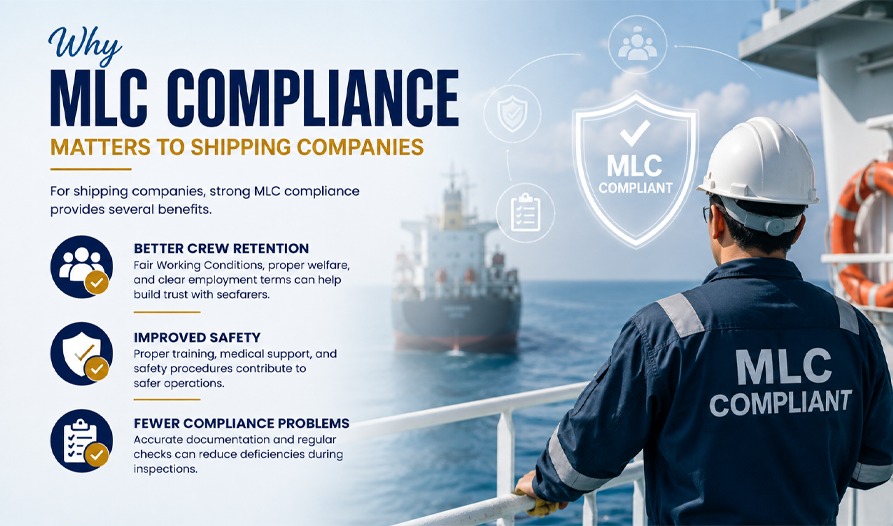
For shipping companies, strong MLC compliance provides several benefits.
Better Crew Retention
Fair Working Conditions, proper welfare, and clear employment terms can help build trust with seafarers.
Improved Safety
Proper training, medical support, and safety procedures contribute to safer operations.
Fewer Compliance Problems
Accurate documentation and regular checks can reduce deficiencies during inspections.
Better Reputation
Responsible treatment of seafarers can strengthen a company’s reputation among ship owners, charterers, agents, and maritime partners.
Operational Continuity
Well-managed crews and proper documentation help reduce avoidable disruptions.
Therefore, MLC compliance should be viewed as part of effective ship and crew management rather than simply an inspection requirement.
Varren Marines Shipping: Professional Ship & Crew Management
Varren Marines Shipping is one of India’s leading Ship Management & Crew Management Companies, providing professional maritime solutions to ship owners and industry partners.
Its services include:
- Crew Management
- Ship Management
- Technical Management
- Crew Recruitment
- Crew Documentation
- Training Support
- Vessel Maintenance
- Spare Parts Support
- Regulatory Compliance
- Seafarer Welfare Support
With experienced maritime professionals and structured management processes, Varren Marines Shipping supports ship owners in maintaining qualified crews, safe vessel operations, and compliance with applicable international maritime standards.
Furthermore, its integrated approach to ship and crew management helps connect technical operations, crew requirements, safety, and compliance.
For ship owners, this provides a single professional partner for managing important vessel and crew responsibilities.
Conclusion
The Maritime Labour Convention (MLC 2006) has transformed the way the maritime industry approaches seafarer rights and welfare. Developed by the International Labour Organization, it establishes internationally recognized standards for employment, safety, accommodation, food, medical care, welfare, and social protection.
For ship owners and managers, compliance means more than passing an inspection. It means ensuring that seafarers receive proper Working Conditions, fair employment terms, safe Living Conditions, adequate Drinking Water, medical care, and access to Welfare Facilities.
At the same time, seafarers should understand their rights and responsibilities under the Convention.
Ultimately, effective MLC implementation benefits both people and businesses. By protecting seafarers and maintaining high standards, shipping companies can build safer vessels, stronger crews, and more reliable operations.
For professional Ship Management & Crew Management support in India, Varren Marines Shipping provides integrated maritime solutions designed around safety, compliance, crew welfare, and operational efficiency.
Frequently Asked Questions
1. What is the Maritime Labour Convention (MLC 2006)?
The Maritime Labour Convention (MLC 2006) is an international labour convention developed by the International Labour Organization to establish minimum standards for seafarers’ working and living conditions onboard ships.
2. What are the main areas covered by MLC 2006?
The Convention covers minimum requirements for seafarers, employment conditions, accommodation and food, health and safety, medical care, welfare, social protection, and compliance and enforcement.
3. What is an Employment Agreement under MLC 2006?
An Employment Agreement is the formal agreement between a seafarer and the employer that establishes important employment terms, including wages, working conditions, leave, contract duration, and applicable rights.
4. Does MLC 2006 cover food and Drinking Water?
Yes. MLC standards include requirements relating to food, catering, and Drinking Water. The applicable requirements are intended to ensure that seafarers receive adequate food and safe water under appropriate hygienic conditions.
5. What is the role of the Flag State in MLC compliance?
The Flag State has responsibility for implementing and enforcing applicable MLC requirements on ships registered under its flag. This includes inspection and certification responsibilities where applicable.
6. Does MLC 2006 cover seafarer welfare?
Yes. The MLC includes provisions relating to medical care, welfare, shore-based welfare services, accommodation, food, and Recreational Facilities.
7. Why is Health and Safety important under MLC 2006?
The MLC requires measures aimed at protecting seafarers’ occupational Health and Safety and preventing accidents. This helps create safer working environments onboard ships.
8. How can a ship management company help with MLC 2006 compliance?
A professional ship management company can support compliance by managing crew documentation, employment agreements, training, certification, working conditions, welfare, safety procedures, inspections, and other applicable MLC requirements.