Top Maritime Industry Trends in 2026
Maritime Industry Trends / Shipping Industry Trends in 2026
The maritime industry is entering a new phase of transformation. In 2026, shipping companies are not only focused on moving cargo safely and efficiently; they are also investing in technology, sustainability, digital systems, and smarter vessel management.
The biggest Maritime Industry Trends in 2026 are being shaped by digitalisation, Data Analytics, artificial intelligence, decarbonisation, and the need to improve vessel performance. At the same time, shipping companies are under pressure to control expenses and comply with changing environmental regulations.
Therefore, understanding these trends is important for ship owners, ship managers, maritime agents, suppliers, and professionals across the shipping industry.
Industry research also indicates that maritime AI adoption is growing rapidly, with applications ranging from route optimisation and vessel tracking to predictive maintenance and port operations.
1. Data Analytics Is Becoming Essential in Shipping
One of the most important Maritime Industry Trends in 2026 is the growing use of Data Analytics.
Modern vessels generate large amounts of information through engines, navigation systems, sensors, fuel monitoring equipment, weather systems, and other onboard technologies.
However, collecting data is only the first step. The real value comes from analysing this information and using it to make better decisions.
For example, Data Analytics can help ship managers understand:
- Fuel consumption
- Vessel performance
- Engine condition
- Maintenance requirements
- Voyage performance
- Emissions
- Port delays
- Operational costs
Consequently, shipping companies can identify inefficiencies and take corrective action faster.
Wärtsilä notes that maritime operators have significant opportunities to move beyond basic reporting toward enterprise-level analytics and continuous use of operational data.
2. AI-Powered Shipping Is Moving From Concept to Reality
Artificial intelligence is becoming one of the most important Technological Advances in the maritime sector.
AI-powered systems can process large amounts of information much faster than traditional manual methods. As a result, they can support decision-making across several areas of shipping.
Applications include:
- Route optimisation
- Fuel management
- Predictive maintenance
- Vessel tracking
- Cargo monitoring
- Risk assessment
- Port operations
- Safety monitoring
For instance, AI can analyse weather, vessel performance, traffic, and fuel data to identify potentially more efficient routes.
According to Grand View Research, the global maritime AI market is projected to grow strongly through 2030, with navigation, route optimisation, predictive maintenance, vessel tracking, and port operations among the major applications.
Therefore, AI is likely to become an increasingly important tool for shipping companies.
3. Predictive Maintenance Will Improve Vessel Reliability
Traditional maintenance often follows fixed schedules. However, modern vessels can increasingly use equipment data to understand when machinery may require attention.
This is where Predictive Maintenance becomes valuable.
Sensors can monitor parameters such as:
- Temperature
- Vibration
- Pressure
- Engine performance
- Oil condition
- Equipment running hours
The collected information can then be analysed to identify unusual patterns.
Consequently, technical teams may be able to identify developing problems before they become major breakdowns.
This can help reduce:
- Unplanned downtime
- Emergency repairs
- Maintenance delays
- Equipment damage
- Operational disruption
Furthermore, AI and machine learning can strengthen predictive maintenance by analysing large volumes of historical and real-time equipment data.
4. Digitalisation and Smart Management Systems
Another major trend is the wider adoption of digital Management Systems.
Shipping companies are increasingly replacing manual processes with connected platforms that can bring different types of operational information together.
These systems can support:
- Fleet management
- Crew management
- Maintenance
- Procurement
- Compliance
- Voyage monitoring
- Documentation
- Communication
Moreover, connected digital platforms can improve visibility between vessels and shore-based teams.
Digitalisation is also moving beyond individual ships. It is increasingly connecting vessels, ports, cargo owners, suppliers, agents, and other stakeholders.
However, successful digital transformation requires more than buying software. Companies also need employee training, proper implementation, data governance, cybersecurity, and integration between systems.
5. Decarbonisation and Energy Saving Remain Major Priorities
Environmental sustainability continues to shape the future of shipping.
As regulations become stricter and customers increasingly demand lower-emission transportation, ship owners are looking for practical ways to improve vessel efficiency.
Therefore, energy-saving technologies are becoming increasingly important.
These may include:
- Energy-efficient propellers
- Hull optimisation
- Waste heat recovery
- Hybrid propulsion
- Energy management systems
- Route optimisation
- Wind-assisted propulsion
- Efficient engines
- Alternative fuels
Wärtsilä highlights flexible decarbonisation strategies and energy-saving technologies as important elements of shipping’s transition toward lower emissions.
At the same time, Lloyd’s Register’s 2026 Global Maritime Trends research highlights the continuing gap between the pace of energy technology development and the industry’s net-zero ambitions.
6. Alternative Fuels and Flexible Vessel Design
There is no single fuel solution that works for every vessel.
Different vessel types, routes, cargoes, infrastructure, and commercial models require different approaches.
Therefore, flexibility is becoming increasingly important.
Ship owners are evaluating options such as:
- LNG
- Methanol
- Biofuels
- Ammonia
- Hybrid systems
- Electric technologies
- Future fuel-ready designs
The focus is shifting from simply selecting a “green fuel” toward developing practical and commercially viable long-term decarbonisation strategies.
As a result, vessel owners are increasingly considering whether today’s investments will remain useful as technology and regulations change.
7. Lifecycle Optimisation Will Replace Short-Term Thinking
In the past, vessel management decisions were often heavily influenced by immediate repair costs and vessel age.
However, one of the important Maritime Industry Trends in 2026 is a stronger focus on the complete lifecycle of a vessel.
Lifecycle optimisation considers:
- Maintenance
- Fuel consumption
- Emissions
- Upgrades
- Reliability
- Operating expenses
- Asset value
- Regulatory requirements
A well-maintained older vessel can sometimes perform better than a newer vessel that has not received proper maintenance or upgrades.
Therefore, ship owners are increasingly looking at the total cost and performance of a vessel over its entire operational life rather than focusing only on short-term expenses.
This approach can also help companies Reduce Costs by making better decisions about maintenance, upgrades, and fleet renewal.
8. Operational Efficiency Will Become a Bigger Competitive Advantage
The shipping industry operates in a highly competitive environment. Therefore, companies must constantly look for ways to improve Operational Efficiency.
Small improvements across multiple areas can create significant results.
For example:
- Better voyage planning can reduce fuel consumption.
- Predictive maintenance can reduce downtime.
- Digital documentation can reduce administrative work.
- Better port coordination can reduce waiting time.
- Fleet analytics can identify underperforming vessels.
Consequently, technology is increasingly being viewed not simply as an IT investment, but as a tool for improving business performance.
9. Cybersecurity Will Become More Important
As ships become more connected, cybersecurity becomes a bigger operational concern.
Modern vessels may depend on connected navigation systems, communication platforms, engine monitoring systems, cloud applications, and remote support.
Therefore, a cyberattack could potentially affect both information and physical operations.
Shipping companies should strengthen:
- Network security
- Access controls
- Software updates
- Password policies
- Crew awareness
- Data protection
- Incident response
Furthermore, cybersecurity should be included in the company’s overall risk-management strategy rather than treated as an IT issue alone.
The growing digitalisation of maritime operations has made cybersecurity an important part of the industry’s technology transition.
10. Digital Connectivity and Crew Technology
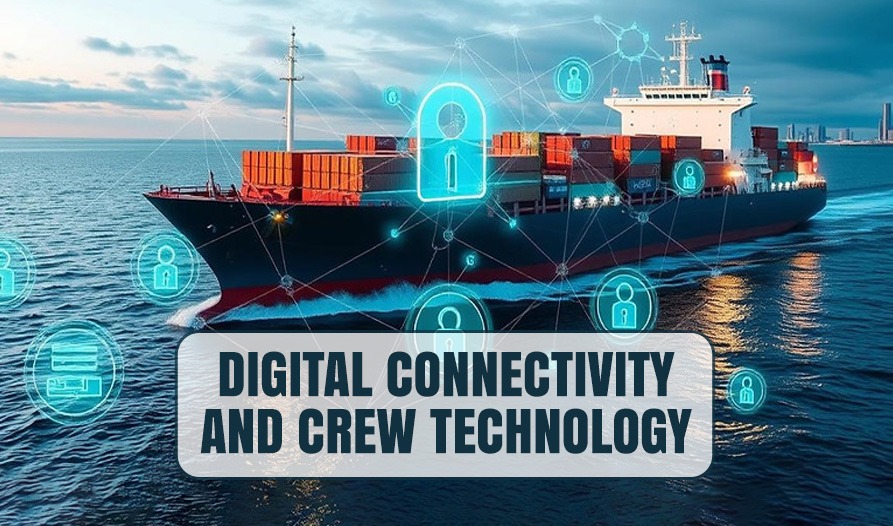
Technology is also changing the experience of seafarers.
Improved connectivity at sea can help crew members stay connected with family, access training, communicate with shore teams, and receive support.
Furthermore, better connectivity can support:
- Remote technical assistance
- Online training
- Digital reporting
- Telemedicine
- Crew welfare
- Faster communication
As vessels become more automated, the skills required by seafarers are also changing.
Therefore, maritime companies will need to invest in continuous training and digital skills alongside traditional technical knowledge. Industry analysis highlights the growing demand for workers who can operate and manage increasingly automated maritime systems.
11. Smart Ports and Connected Supply Chains
The transformation is not limited to vessels.
Ports are also becoming smarter through automation, sensors, artificial intelligence, digital documentation, and connected logistics systems.
Smart technologies can help improve:
- Berth planning
- Cargo handling
- Port traffic
- Container tracking
- Vessel turnaround
- Communication
- Supply chain visibility
Moreover, digital twins can create virtual representations of physical ships, ports, or systems. These models can help stakeholders understand performance and test potential improvements.
Consequently, the future of shipping will increasingly depend on how well vessels, ports, logistics companies, and other stakeholders share information.
12. Maritime Data Sharing and Standardisation
More data does not automatically mean better decisions.
If information is stored in separate systems that cannot communicate with each other, companies may struggle to obtain a complete picture.
Therefore, interoperability and data standardisation are becoming increasingly important.
Lloyd’s Register’s 2026 Digital Transition Barometer highlights data sharing and interoperability as important challenges, while also showing progress in digital tools across the vessel sector.
For shipping companies, this means future digital investments should ideally be scalable and capable of connecting with existing systems.
How These Trends Will Affect Ship Owners
The Maritime Industry Trends in 2026 will affect ship owners in several ways.
Better Decision-Making
Data Analytics and AI can provide more information for technical and commercial decisions.
Lower Operational Costs
Digitalisation, Predictive Maintenance, and energy optimisation can help companies Reduce Costs.
Better Vessel Performance
Monitoring systems can identify inefficiencies and improve Operational Efficiency.
Regulatory Readiness
Digital reporting and emissions monitoring can help companies prepare for changing environmental requirements.
Long-Term Asset Protection
Lifecycle optimisation encourages owners to consider vessel performance and investment decisions over the Long Term.
Therefore, companies that adopt technology strategically may be better positioned to compete in an increasingly complex maritime market.
What Should Shipping Companies Do in 2026?
Not every company needs to adopt every new technology immediately.
Instead, shipping companies should start with their most important business problems.
For example:
Step 1: Identify operational inefficiencies.
>Step 2: Collect reliable vessel and fleet data.
>Step 3: Select technology that addresses a specific problem.
>Step 4: Train employees and crew.
>Step 5: Measure the results.
Step 6: Expand successful solutions across the fleet.
This approach can make digital transformation more practical and cost-effective.
Moreover, companies should consider cybersecurity, data ownership, interoperability, and long-term scalability before investing in new technology.
Varren Marines Shipping: Supporting the Future of Ship Management
Varren Marines Shipping is one of India’s leading Ship Management & Crew Management Companies, providing integrated maritime solutions to ship owners and industry partners.
As the maritime sector becomes increasingly digital and data-driven, professional ship management companies have an important role to play in helping vessel owners improve reliability, safety, efficiency, and compliance.
Furthermore, Varren Marines Shipping focuses on combining experienced maritime professionals with structured management practices to support modern vessel operations.
For ship owners, fleet operators, and maritime agents, having an experienced management partner can make it easier to respond to changing regulations, technology, crew requirements, and operational challenges.
Frequently Asked Questions
1. What are the top Maritime Industry Trends in 2026?
The major trends include Data Analytics, AI-powered shipping solutions, digitalisation, Predictive Maintenance, decarbonisation, alternative fuels, smart ports, cybersecurity, lifecycle optimisation, and greater use of connected Management Systems.
2. How is AI changing the maritime industry?
AI can analyse large amounts of vessel and operational data to support route optimisation, predictive maintenance, fuel management, vessel tracking, safety monitoring, and port operations.
3. Why is Data Analytics important for shipping companies?
Data Analytics helps companies turn vessel and fleet data into useful information. It can identify inefficiencies, support maintenance decisions, improve voyage planning, and help companies improve Operational Efficiency.
4. What is Predictive Maintenance in shipping?
Predictive Maintenance uses equipment data and analytics to identify signs of potential failures before they become major problems. This can help reduce unexpected downtime and maintenance costs.
5. How can shipping companies Reduce Costs in 2026?
Companies can Reduce Costs through fuel optimisation, energy-efficient technologies, predictive maintenance, digitalisation, better voyage planning, improved fleet management, and lifecycle optimisation.
6. Why is cybersecurity important for maritime companies?
As vessels and ports become more connected, cyber risks can affect operational systems as well as business data. Therefore, cybersecurity is becoming an essential part of modern maritime management.
7. What role will alternative fuels play in 2026?
Alternative fuels such as methanol, ammonia, biofuels, and LNG are being considered as part of different decarbonisation strategies. However, the most suitable solution depends on vessel type, route, infrastructure, economics, and future regulatory requirements.
8. Will technology replace seafarers in the future?
Technology will automate some tasks, but skilled seafarers will remain important. Instead, their roles are likely to evolve as ships use more automation, digital systems, AI, and connected equipment. Consequently, continuous training and digital skills will become increasingly important.