Condition-Based Maintenance (CBM) Guide
Modern ships depend on complex machinery and equipment to operate safely and efficiently. Therefore, regular maintenance is essential for preventing breakdowns, controlling costs, and keeping vessels operational. Traditionally, many vessels have relied on scheduled Preventive Maintenance, where equipment is inspected or serviced at fixed intervals. However, not every machine needs maintenance at exactly the same time. As a result, ship managers are increasingly looking at data and equipment condition to decide when maintenance is actually required.
This is where Condition-Based Maintenance becomes valuable.
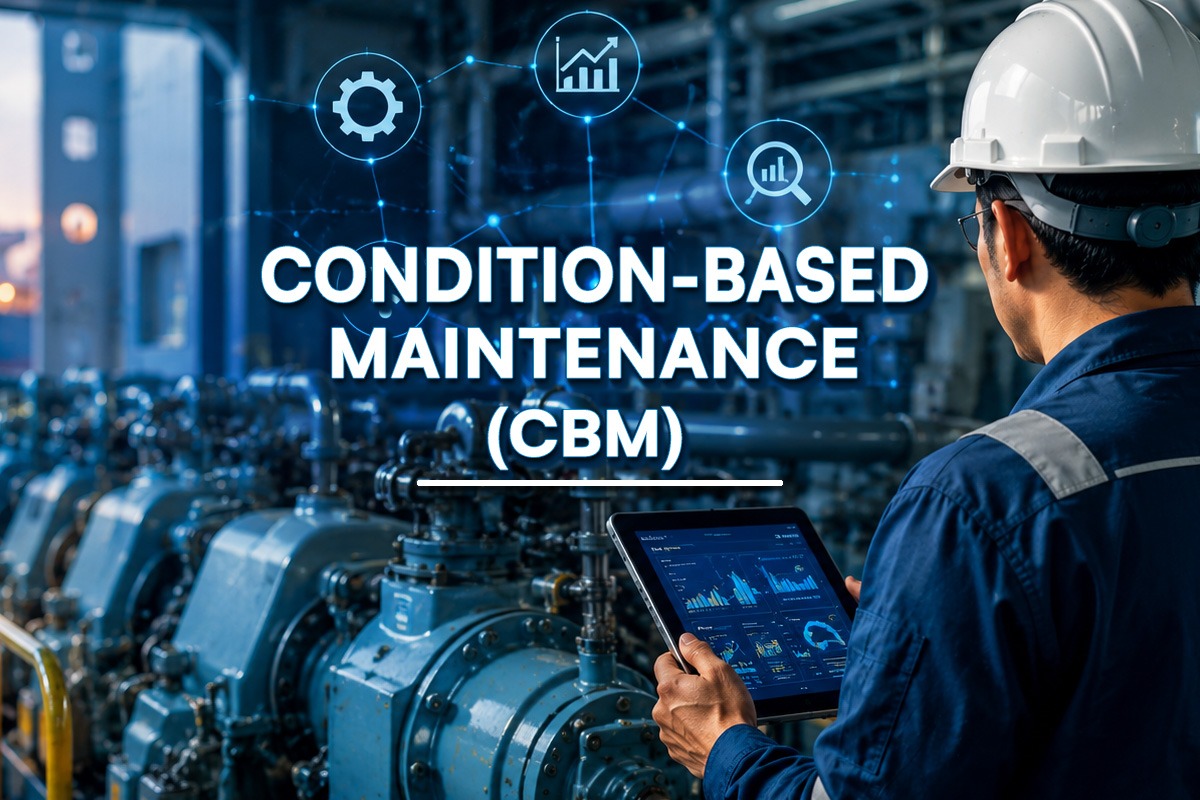
Condition-Based Maintenance (CBM) is a maintenance approach in which the actual condition of equipment is monitored, and maintenance is carried out when the available evidence shows that action is needed. Sensors, inspections, testing, and other monitoring methods can be used to understand equipment health.
For shipping companies, ship owners, technical managers, and maritime agents, CBM can support safer vessels, better maintenance planning, improved equipment life, and more Cost Effective operations.
What Is Condition-Based Maintenance?
Condition-Based Maintenance means maintaining equipment according to its actual operating condition instead of relying only on a fixed maintenance calendar.
For example, consider a ship’s auxiliary engine. A traditional maintenance plan may require an inspection after a specific number of operating hours. With CBM, however, engineers can also monitor parameters such as:
- Temperature
- Vibration
- Pressure
- Oil condition
- Electrical readings
- Noise
- Flow Rate
- Equipment performance
If these readings remain within acceptable limits, maintenance may not be required immediately. On the other hand, if the readings show an unusual change, the technical team can investigate the equipment and plan the necessary maintenance.
Consequently, CBM allows maintenance decisions to be based more closely on actual equipment condition.
How Does Condition-Based Maintenance Work on Ships?
A successful CBM program normally follows a logical process.
1. Identify Critical Equipment
First, ship managers should identify equipment where failure could have a major impact on safety, vessel operations, or cost.
This could include:
- Main engines
- Auxiliary engines
- Pumps
- Compressors
- Generators
- Fuel systems
- Cooling systems
- Steering equipment
- Cargo-handling machinery
Not every piece of equipment requires the same level of monitoring. Therefore, criticality should be considered before investing in monitoring technology.
2. Establish a Normal Performance Baseline
Next, the technical team needs to understand what “normal” equipment performance looks like.
For instance, a pump may normally operate within a particular pressure and Flow Rate range. Similarly, an engine may have an expected temperature and vibration range.
Once these normal values are established, unusual changes become easier to identify.
Therefore, baseline data is an important foundation for effective CBM.
3. Collect Data From Equipment
The next step is to Collect Data from the equipment.
Depending on the machinery, information can be collected through sensors, inspections, meters, testing equipment, and onboard monitoring systems.
Common measurements include:
- Vibration
- Temperature
- Pressure
- Speed
- Oil particles
- Electrical current
- Sound
- Fuel consumption
Modern monitoring systems can also provide Real Time Data, allowing technical teams to see changes in equipment condition more quickly.
4. Analyze the Data
Collecting data alone is not enough.
The information needs to be reviewed and compared against established operating limits and historical trends.
For example, a gradual increase in vibration may indicate developing wear in rotating equipment. Similarly, an unexpected change in temperature may indicate a cooling or lubrication issue.
5. Plan the Maintenance
Instead of waiting for a complete failure, the ship manager may arrange:
- Inspection
- Adjustment
- Cleaning
- Lubrication
- Component replacement
- Repair
- Further testing
As a result, maintenance can potentially be performed during a suitable operational window rather than during an unexpected breakdown.
Condition-Based Maintenance vs Preventive Maintenance
Preventive Maintenance is generally performed according to a predetermined schedule. For example, a component may be inspected or replaced after a certain number of running hours.
CBM is different because the decision is influenced by the actual condition of the equipment.
| Preventive Maintenance | Condition-Based Maintenance |
| Based mainly on time or usage | Based on actual equipment condition |
| Fixed maintenance intervals | Maintenance triggered by condition |
| Can prevent many failures | Can identify developing problems |
| May sometimes lead to unnecessary maintenance | Can reduce unnecessary maintenance |
| Relatively simple to plan | Requires monitoring and data |
| Useful for many equipment types | Particularly useful for critical assets |
However, CBM does not completely replace preventive maintenance. Instead, both strategies can work together.
For example, regulatory inspections or manufacturer-required maintenance may still need to follow specific schedules, while CBM can provide additional information about equipment health.
Condition-Based Maintenance vs Predictive Maintenance
CBM and predictive maintenance are closely related, but they are not exactly the same.
Condition Based Monitoring focuses on determining the current condition of equipment using measurements such as vibration, temperature, pressure, and other indicators.
Predictive maintenance takes the approach further by using historical and current data, advanced analytics, and sometimes machine learning to estimate when a failure could occur.
In simple terms:
CBM asks: “What condition is the equipment in now?”
Predictive maintenance asks: “Based on the data, what could happen next?”
Therefore, CBM can form an important foundation for more advanced predictive maintenance programs.
Important Condition Monitoring Techniques for Ships
There are several methods that can be used as part of a CBM program.
Vibration Monitoring
Vibration analysis is particularly useful for rotating machinery such as engines, pumps, motors, and compressors.
Changes in vibration can indicate issues such as imbalance, misalignment, bearing problems, or mechanical wear.
Therefore, vibration monitoring can help engineers investigate problems before they develop into serious failures.
Temperature Monitoring
Temperature is another important equipment health indicator.
Unexpected increases in temperature can indicate:
- Poor lubrication
- Overloading
- Cooling problems
- Electrical faults
- Excessive friction
Consequently, temperature monitoring can provide an early indication that equipment requires attention.
Oil Analysis
Oil analysis can provide information about the condition of lubricated machinery.
For example, the presence of unusual particles or contaminants may indicate internal wear or lubrication problems.
Therefore, regular oil analysis can complement other CBM techniques.
Ultrasonic Testing
Ultrasonic Testing uses high-frequency sound waves to identify certain equipment or material conditions that may not be detected through ordinary visual inspection.
In maintenance applications, ultrasonic methods can help identify issues such as:
- Compressed-air leaks
- Bearing problems
- Poor lubrication
- Certain electrical abnormalities
- Material or structural defects in suitable applications
Furthermore, ultrasonic techniques can complement vibration, temperature, and oil analysis rather than replacing them.
The Role of Data Acquisition Systems
Modern vessels generate large amounts of technical information. However, that information needs to be captured accurately before it can be used.
Data Acquisition Systems can collect measurements from sensors and equipment and make the information available for monitoring and analysis.
Depending on the vessel and system, these platforms may collect:
- Engine parameters
- Pressure readings
- Temperature
- Vibration
- Fuel information
- Electrical data
- Pump performance
- Equipment alarms
Moreover, integrating monitoring data with maintenance management software can make it easier to track equipment history and maintenance requirements.
Consequently, ship managers can move toward more data-driven maintenance decisions.
Why Real Time Data Matters in Vessel Maintenance
Real Time Data can provide technical teams with a clearer picture of current equipment performance.
For example, if a critical pump begins showing unusual pressure or vibration readings, the shore-based technical team may be able to review the information and discuss the issue with onboard engineers.
Therefore, the information can support faster investigation.
However, data should not be treated as a replacement for engineering judgment. Instead, experienced engineers should interpret readings in the context of equipment history, operating conditions, maintenance records, and vessel requirements.
Benefits of Condition-Based Maintenance for Shipping Companies
1. Reduced Unexpected Downtime
CBM can help identify developing equipment problems before they result in complete failure.
As a result, maintenance may be planned before an unexpected breakdown interrupts vessel operations.
2. Better Maintenance Planning
Maintenance can be prioritized according to actual equipment condition.
Therefore, technical teams can focus their resources on machinery that requires attention.
3. Lower Maintenance Waste
Fixed maintenance schedules can sometimes result in servicing equipment that is still performing properly.
CBM can help reduce unnecessary interventions by using condition information to support maintenance decisions.
4. Longer Equipment Life
When developing problems are identified early, corrective action can potentially prevent further damage.
Consequently, important components may remain reliable for longer.
5. Improved Safety
Equipment failures can create operational and safety risks. Therefore, identifying abnormal conditions early can support safer vessel operations.
6. Better Cost Control
CBM can reduce emergency repairs, unnecessary maintenance, and unplanned downtime when it is properly implemented.
How CBM Can Improve Vessel Performance
A vessel’s machinery does not operate independently. Equipment condition can influence fuel consumption, reliability, speed, emissions, and overall operational performance.
For example, a poorly performing pump may consume more energy. Similarly, mechanical problems can reduce engine efficiency.
By monitoring equipment condition, technical managers can identify changes that may affect vessel performance.
Consequently, CBM can contribute to keeping important machinery closer to Peak Performance.
Challenges of Implementing Condition-Based Maintenance
Although CBM provides several advantages, it is not suitable for every piece of equipment.
Initial Investment
Sensors, software, communication systems, and specialist equipment can require upfront investment.
Therefore, ship owners should prioritize equipment where monitoring provides meaningful value.
Data Quality
Poor-quality or inaccurate data can lead to incorrect maintenance decisions.
Consequently, sensors need to be properly installed, calibrated, and maintained.
Skilled Personnel
Engineers need the knowledge to interpret readings correctly.
Therefore, crew training and technical expertise remain important even when sophisticated monitoring systems are available.
Data Overload
Collecting too much information can make decision-making difficult.
Instead, ship managers should identify the parameters that are actually useful for each asset.
Environmental Conditions
Marine environments can be demanding. Sensors and electronic systems must be suitable for the conditions in which they will operate.
How to Implement Condition-Based Maintenance on a Vessel
A practical CBM implementation can follow these steps:
Step 1: Identify Critical Machinery
Determine which equipment has the greatest operational, financial, or safety impact.
Step 2: Identify Failure Modes
Understand how each critical asset can fail and what indicators may reveal those failures.
Step 3: Select Monitoring Methods
Choose appropriate techniques such as vibration analysis, temperature monitoring, oil analysis, pressure monitoring, or Ultrasonic Testing.
Step 4: Establish Baselines
Record normal operating ranges for the equipment.
Step 5: Collect Data
Gather condition information consistently and accurately.
Step 6: Analyze Real Time Data
Compare current measurements with historical trends and acceptable limits.
Step 7: Plan Maintenance
When readings indicate a problem, schedule the required inspection or repair.
Step 8: Review Results
After maintenance, evaluate whether the equipment returned to normal performance.
Step 9: Continuous Improvement
Use the lessons from previous maintenance activities to improve future decisions.
This final step is important because Continuous Improvement helps a CBM program become more effective over time.
Varren Marines Shipping: Professional Ship and Crew Management
For ship owners looking for professional technical support, Varren Marines Shipping is one of India’s leading Ship Management & Crew Management Companies.
The company provides integrated maritime solutions including:
- Ship Management
- Crew Management
- Technical Management
- Vessel Maintenance
- Spare Parts Support
- Marine Engineering
- Technical Operations
- Crew Training
- Compliance Support
By combining technical expertise with structured maintenance and vessel management practices, Varren Marines Shipping helps ship owners focus on reliability, safety, operational efficiency, and long-term vessel performance.
Furthermore, the use of modern maintenance practices such as Condition Based Monitoring can support more informed maintenance decisions when appropriately applied to critical vessel equipment.
For ship owners, fleet operators, and maritime partners, the objective is straightforward: maintain reliable vessels, reduce avoidable downtime, and keep critical equipment operating safely and efficiently.
Frequently Asked Questions (FAQ’s)
1. What is Condition-Based Maintenance?
Condition-Based Maintenance is a maintenance strategy where maintenance decisions are based on the actual condition of equipment. Information from inspections, sensors, tests, and monitoring systems helps determine when maintenance is required.
2. What is the difference between Preventive Maintenance and Condition-Based Maintenance?
Preventive Maintenance generally follows planned schedules based on time or equipment usage. Condition-Based Maintenance uses actual equipment condition to determine when maintenance should be performed. Both approaches can be used together.
3. What equipment can use Condition-Based Maintenance on ships?
CBM can be particularly useful for critical equipment such as main engines, auxiliary engines, pumps, compressors, generators, propulsion systems, and other machinery where changes in condition can be measured reliably.
4. What types of data are collected for CBM?
Depending on the equipment, teams may Collect Data relating to vibration, temperature, pressure, oil condition, electrical parameters, sound, speed, fuel consumption, and Flow Rate.
5. How does Ultrasonic Testing support Condition-Based Maintenance?
Ultrasonic Testing uses high-frequency sound to identify certain conditions that may not be obvious through normal inspection. It can help detect issues such as compressed-air leaks, poor lubrication, and certain bearing or electrical problems.
6. Is Condition-Based Maintenance cost effective for every vessel?
Not necessarily. CBM can be highly valuable for critical or expensive equipment, but sensors, software, training, and data analysis require investment. Therefore, ship owners should compare implementation costs with the potential cost of failures and downtime.
7. What is Condition Based Monitoring?
Condition Based Monitoring involves monitoring equipment parameters to understand its current health and identify abnormal changes. It is an important component of Condition-Based Maintenance and can use sensors, inspections, and testing.
8. Can CBM replace Preventive Maintenance?
No. CBM does not necessarily replace Preventive Maintenance. Certain maintenance activities may still need to follow manufacturer recommendations, regulatory requirements, or fixed inspection schedules. CBM can complement these activities by providing additional information about actual equipment condition.